
A recent report published by
Infinium Global Research on IoT in smart household market provides in-depth
analysis of segments and sub-segments in the global as well as regional IoT in
smart household market . The study also highlights the impact of drivers,
restraints, and macro indicators on the global and regional IoT in smart
household market over the short term as well as long term. The report is a
comprehensive presentation of trends, forecast and dollar values of global IoT
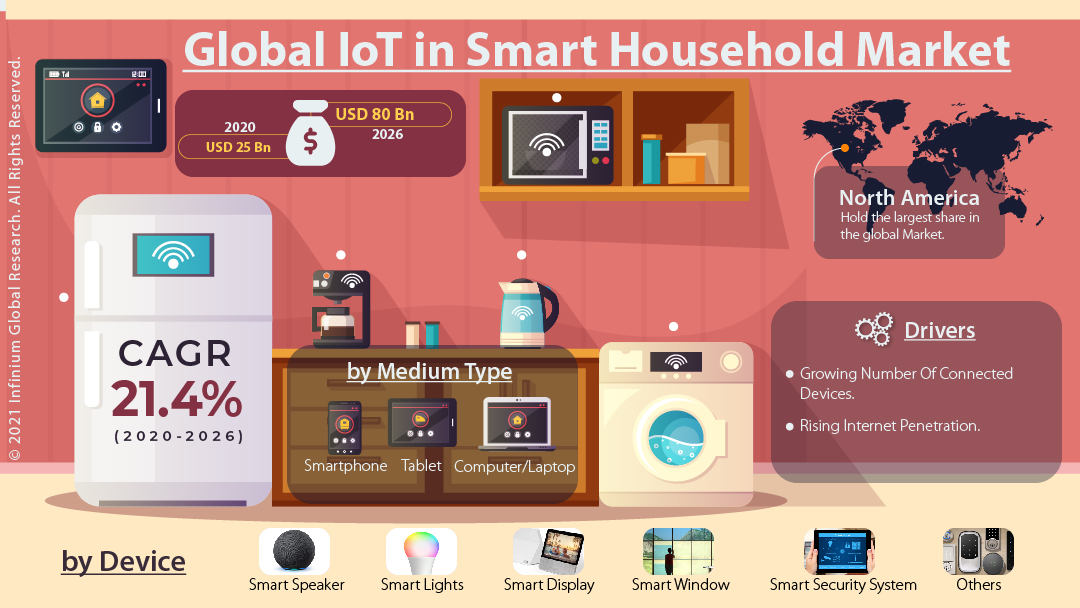
in smart household market. According to the report, the global IoT in smart
household market was worth USD 25 billion in 2020 and is expected to reach USD 80
Billion by 2026, growing with a is projected to grow at a CAGR of 21.4% over
the forecast period of 2020-2026.
All smart home appliances are
connected through IoT. Through IoT, it becomes easy to control all the other
smart appliances from one central controller. The data gathered can be used to
analyze and important insights can be obtained. These insights can help in
bringing down the costs. IoT plays an important role in smart home automation.
The manual operations in a home can be automated and controlled through IoT.
For the implementation of IoT in smart household hardware as well as software
is required. Hardware such as wi-fi routers to connect all the devices and
software such as mobile applications to remotely control these connected
devices from one central point. Several new features such as voice control are
being actively incorporated in IoT solutions for the smart household.
A lot of people were working from home during the COVID-19 pandemic. The home appliances connected through IoT provided relief from household chores to the people who were working from home. Therefore the demand increased in the market. However, installation and availability of new IoT solutions halted due to the implementation of lockdown around the world. Nevertheless, the development of new IoT smart home solutions and software were not hampered. The boost in the demand due to the COVID-19 pandemic is expected to sustain for a long period of time in the market. The installation services are also been facilitated as the restrictions are being eased.
Connected devices are growing
rapidly in the market. Their adoption rate is high. The companies are offering
new smart and connected devices to the customers. They come loaded with a lot
of advanced features. The connected smart security system is gaining traction
in the smart home devices market and customers are showing a lot of interest in
it. It provides all-around security in a smart way. The internet penetration is
rising complemented by the growing number of smartphone and tablet users. The
strong internet connectivity ensures the IoT smart household systems and
solutions work flawlessly and without any interruption. The Telecom operators
are putting emphasis on the up-gradation of telecom infrastructure.
Additionally, internet prices are declining and are becoming more affordable.
There are many companies that are offering IoT solutions for smart home and
home automation. This enables the customer to select the best IoT solution
according to the requirements from a wide product portfolio. These factors are
driving the market. The cost of the IoT solutions for smart home and home
automation is high. This hampers its adoption. This factor is restraining the
market. New product and solution launches in the market are expected to provide
new opportunities.
North America is expected to be the dominant region in the market. Asia-Pacific is expected to grow at the fastest rate in the market. In North America, the trend of smart home and home automation is growing rapidly. The increasing pace of life is prompting the people in the region to adopt the latest technologies such as IoT smart home solutions. Companies such as Amazon, Inc. are also present in the region who are world leaders in offering IoT solutions for smart home and home automation. Asia-Pacific is experiencing a boom in economic growth. Urbanization is also happening in the region on large scale. The smart city concept is being effectively adopted by many countries in the Asia-Pacific region.
The report on global IoT in smart
household market covers segments such as medium type, and device. On the basis
of medium type, the sub-markets include smartphone, tablet, and
computer/laptop. On the basis of device, the sub-markets include smart speaker,
smart lights, smart display, smart window, smart security system, and others.
The report provides profiles of
the companies in the market such as Amazon.com, Inc., IOTAS, Inc., Peerbits,
Develco Products, Digiteum, LifeSmart Inc, Control4 Corporation, thethings.iO,
Toptal, LLC, and Andrus Smart Technologies.
The report provides deep insights
into the demand forecasts, market trends, and micro and macro indicators. In
addition, this report provides insights into the factors that are driving and
restraining the growth in this market. Moreover, The IGR-Growth Matrix analysis
given in the report brings an insight into the investment areas that existing
or new market players can consider. The report provides insights into the
market using analytical tools such as Porter's five forces analysis and DRO
analysis of IoT in smart household market . Moreover, the study highlights
current market trends and provides forecast from 2020-2026. We also have
highlighted future trends in the market that will affect the demand during the
forecast period. Moreover, the competitive analysis given in each regional
market brings an insight into the market share of the leading players.